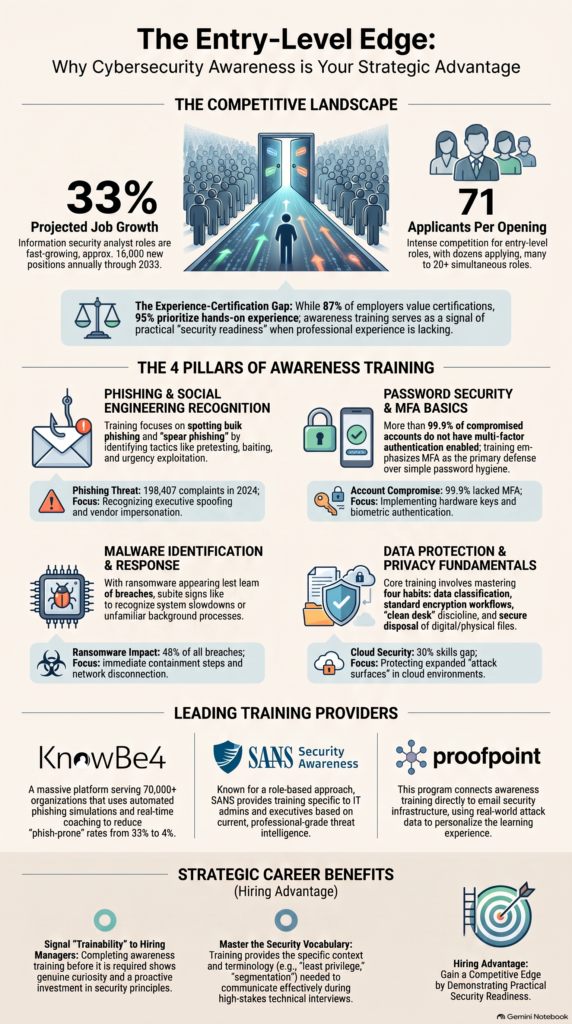
Information security analyst jobs are projected to grow 33% from 2023 to 20331, which means thousands of entry-level positions are opening up across cybersecurity and related IT roles. Employers filling these spots want candidates who already understand threats, can spot a phishing attempt, and know how to follow security protocols from day one.
The problem? A lot of entry-level IT professionals skip cybersecurity awareness training altogether. The assumption is that technical certifications will be enough to land the job. That assumption is costing people interviews.
This article breaks down why cybersecurity awareness training programs matter, what they actually teach, and how completing one can put you ahead of other candidates going after the same roles.
Why Cybersecurity Threats Are Creating More Entry-Level Jobs
Job growth driven by attack frequency
Cyberattacks are no longer isolated incidents. Organizations face them on a continuous basis, and the pressure to defend against them has created an urgent, sustained demand for security professionals who can prevent hackers from stealing critical information or disrupting computer networks2.
The numbers tell a clear story. Information security analysts will see 29% employment growth from 2024 to 2034, with roughly 16,000 new positions opening every year2. That growth rate ranks cybersecurity among the fifth fastest-growing occupations across all fields in the United States3. Nationally, 457,398 cybersecurity job postings appeared in 2025 alone4.
Specialized hiring is also accelerating. Response category roles grew by an extraordinary 100.89% in 20235, reflecting how seriously organizations are taking complex, fast-moving threats. These roles need staff who can identify an attack while it’s happening — not after the damage is done. Employers want people who’ve completed cybersecurity awareness training programs and can recognize threats from the start.
Regulatory requirements are adding even more positions to the mix. Privacy, compliance, and risk management directives now influence hiring decisions at 40% of organizations worldwide5 — and in Europe, that figure climbs to nearly 50%5. Regulations don’t just shape policy; they directly create entry-level roles for candidates who understand security fundamentals.
Industries hiring security-aware IT staff
The demand cuts across nearly every sector, not just tech companies.
Financial services firms need security-conscious IT staff to prevent fraud, protect online banking systems, and stay compliant with regulations6. Banks and investment firms sit at the top of attackers’ target lists because of the financial data they hold.
Healthcare organizations are hiring to protect electronic health records and meet HIPAA requirements6. The rapid expansion of telemedicine opened up new vulnerabilities, creating more roles for those who understand ransomware defense and patient data security.
Government agencies at every level — federal, state, and local — require cybersecurity professionals to safeguard national infrastructure and classified information6. Schools and universities are bringing in security-aware staff to protect student records and research data6. Retail and eCommerce businesses need coverage for customer payment data as digital transactions continue to grow6.
Technology companies place security professionals across product development, cloud infrastructure, and intellectual property protection6. Power plants, water treatment facilities, and other critical infrastructure operators hire staff specifically to protect operational technologies from disruption6.
How threat evolution opens doors for beginners
Newer technologies are creating security needs that didn’t exist a few years ago. Cloud computing security currently represents the second most significant skills gap in the field at 30%, just behind AI at 34%5. These environments work differently from traditional IT setups, and organizations need people who understand those differences.
Each step toward cloud adoption or IoT implementation expands an organization’s attack surface. More digital infrastructure means more ground to cover, and more positions to fill5.
There’s an honest reality worth knowing before you start applying: a surplus of professionals with 0-2 years of experience already exists7. Entry-level candidates have real competition, and similar job titles on a resume don’t help you stand out. Employers are specifically looking for people who show genuine curiosity about security principles, current threats, and how to reduce risk8. They want candidates who stay current on trends, can support security policy development, and will flag potential issues before they escalate8.
Cybersecurity awareness training is one of the clearest ways to show that kind of readiness. Programs like those at Northeast Technical Institute give beginners the practical knowledge employers are looking for — and they signal that you’ve already invested in understanding security before walking into an interview. That matters more than most entry-level candidates realize.
What Cybersecurity Awareness Training Actually Covers
“Amateurs hack systems; professionals hack people.” — Bruce Schneier, Security technologist and author
“Amateurs hack systems; professionals hack people.” — Bruce Schneier, Security technologist and author
That quote gets at something most entry-level candidates miss. Security threats are not just technical problems. They are human problems. Good awareness training addresses both sides.
Phishing and social engineering recognition
Phishing topped the list of reported cybercrimes with 193,407 complaints in 20249. That number tells you something important: attackers keep using phishing because it keeps working.
Awareness training programs teach you to tell the difference between bulk phishing, spear phishing, and business email compromise, because spotting one does not mean you can spot the others10. Frontline staff learn the common warning signs: urgent language, sender domains that don’t quite match, unexpected attachments, and requests to enter credentials10. Finance and HR teams go deeper into business email compromise tactics, particularly vendor impersonation and executive spoofing, which tend to drive high-value fraud10.
The reason people fall for phishing is not ignorance. Employees click because the email looks believable and arrives at exactly the wrong moment10. Social engineering works by triggering psychological responses that skip rational thinking entirely10. Training covers the four tactics attackers rely on most:
- Pretexting — fabricating a believable scenario to gain trust
- Baiting — offering something desirable to prompt impulsive action
- Tailgating — physically following authorized personnel into secured areas
- Urgency exploitation — creating time pressure to prevent verification10
Entry-level employees are especially vulnerable to authority-based pretexting. An attacker posing as IT support and asking for a password reset is banking on your instinct to defer to someone in a position of authority10.
Password security and access control basics
More than 99.9% of compromised accounts had no multi-factor authentication enabled10. That single finding shapes how every authentication module in awareness training is built.
Password hygiene still matters — minimum length requirements, avoiding reuse across services, using a password manager — but MFA is what actually reduces risk at scale10. Password managers handle the heavy lifting by generating complex passwords and storing them in encrypted format, so you are not memorizing anything or writing credentials down somewhere unsafe1111.
Training also walks through which MFA methods hold up under real attack conditions. Hardware security keys and biometrics resist phishing attempts. SMS-based codes are vulnerable to SIM-swapping and should be treated as a fallback, not a primary control10.
Malware identification and response
Ransomware appeared in 48% of all breaches, up from 44% the year before10. What makes it particularly dangerous is that it rarely announces itself early. Employees at all levels learn to recognize the subtle signs: systems slowing down without explanation, unexpected file encryption prompts, or unfamiliar processes consuming network bandwidth10.
Training also addresses the specific behaviors that let malware in — downloading unapproved software, plugging in a USB drive found in a parking lot, or enabling macros in a document from an unknown sender10. For IT and operations staff, the instruction goes further into containment steps: disconnect the affected machine from the network immediately, do not power it down (that preserves forensic evidence), and notify security personnel before attempting anything yourself10.
Data protection and privacy fundamentals
This part of training builds four practical habits rather than asking employees to memorize policy documents:
- Classification levels tied to handling rules, so you know how to treat a file based on what it contains
- Encryption as a standard workflow step, not something reserved for the security team
- Clean desk and clear screen discipline to prevent shoulder surfing and unauthorized physical access
- Secure disposal covering both digital files and physical documents10
On the privacy side, training focuses on data subject rights under regulations like GDPR12. The practical takeaway is understanding how your organization is required to handle personal data and what policies exist to give individuals control over their own information12.
Incident reporting and escalation procedures
When employees do not know how to report an incident, response gets delayed, evidence gets corrupted, and the damage grows13. This module gives you a clear process: what counts as suspicious activity, how to report it, and what happens after you do14.
One thing good training does well here is reframe the act of reporting. Fast reporting is treated as the right call, not an admission of a mistake. The reporting path needs to be confidential, easy to find, and genuinely supported by leadership, not just listed somewhere in a policy document10.
How Training Separates You from Other Entry-Level Candidates
What hiring managers expect from new IT hires
IT security positions draw 71 applicants per opening on average15. Most candidates apply to 20 or more roles at the same time, which means you could realistically be competing with around 1,420 people for a single position15. Hiring managers sorting through that volume see the same certifications, the same project descriptions, and the same listed responsibilities over and over.
Technical ability matters, but it rarely decides who gets the offer. Hiring managers look for candidates who meet the full picture of a role, not just one in-demand skill16. Communication ability consistently ranks among the most valued qualities in cybersecurity hiring16. You’ll write incident reports for executives who have no technical background. You’ll walk stakeholders through risks they don’t fully understand. That takes more than knowing the material — it takes being able to explain it clearly.
When assessing candidates, 95% of employers say hands-on experience is somewhat or very important17. Another 87% place IT and cybersecurity credentials at similar weight17. Hiring managers use both as quick screening filters precisely because there are far more applicants than open seats18.
Training as proof of security readiness
Employers actively favor certified candidates, treating completed training as a reliable signal of what someone can actually do19. Nine out of ten corporate executives say they prefer hiring people with technology-focused qualifications19, and the same proportion would fund certification for existing staff19.
Still, over 70% of employers report difficulty finding candidates with those credentials19. That gap works in your favor — if you’ve done the work. Cybersecurity awareness training closes the distance between saying you’re interested in security and being able to demonstrate you understand it20. It shows you invested time before someone required you to. That matters to hiring managers assessing whether someone is trainable17.
For entry-level candidates and career changers especially, certifications and completed training signal commitment when professional experience isn’t there yet18. Programs like those at Northeast Technical Institute combine awareness training with hands-on technical instruction, giving you the kind of preparation employers can see and trust.
How awareness training complements technical certifications
Technical certifications confirm you know specific things. Cybersecurity awareness training gives those skills context that certifications alone rarely provide. CompTIA Security+ is widely held, which means hiring managers expect it — but it won’t distinguish you from the dozens of other Security+ holders in the applicant pool1616.
Candidates who leave an impression are the ones who can talk through how they’d actually apply what they’ve learned21. Awareness training builds that ability. It gives you the vocabulary that shows up in job descriptions, interview questions, and incident documentation20 — terms like authentication, least privilege, and segmentation used correctly in context, not just listed on a resume20.
When you combine awareness training with certifications and lab practice, the result can substitute for direct work experience in many hiring conversations22. Employers who understand the talent gap aren’t going to pass on a well-prepared candidate simply because they’re new to the field22.
Common Cybersecurity Awareness Training Programs Worth Considering
“Employee cybersecurity awareness training falls within the CIS Controls® for good reason. All breaches begin with the human factor; putting in the effort to harden those vectors for attack is equally if not more important than any software or hardware hardening.” — Mathew Everman, Information Security Operations Manager at CIS
“Employee cybersecurity awareness training falls within the CIS Controls® for good reason. All breaches begin with the human factor; putting in the effort to harden those vectors for attack is equally if not more important than any software or hardware hardening.” — Mathew Everman, Information Security Operations Manager at CIS
Choosing a training program comes down to your budget, learning goals, and how much structure you need. Here’s a look at the most widely used options and what each one actually offers.
KnowBe4 Security Awareness Training
KnowBe4 serves more than 70,000 organizations worldwide23. The platform combines automated phishing simulations, real-time coaching, and personalized content delivery based on individual risk scores23. What makes it stand out is when the coaching happens — security tips appear the moment a risky behavior occurs, not days after the fact23.
The platform brings phish-prone rates down from an industry average of 33.1% to 4.1% within 12 months23. Pricing starts at $3 per user monthly24, and content is available in 35+ languages23. Users generally find the content library extensive and the admin console easy to work with, though some note the interface looks a bit outdated25.
SANS Security Awareness
SANS Workforce Security and Risk Training takes a role-based approach, building content around current threat intelligence rather than generic security topics26. End users, IT administrators, and executives each get material specific to what they actually encounter on the job26.
Pricing sits at approximately $3 per user monthly24. For those pursuing a credential, the SANS LDR433 three-day course leads to the SSAP certification, which requires passing a 50-question exam with a score of 78% or higher27. The content is authored by cybersecurity professionals and can be customized, though campaign management is more hands-on compared to platforms with automated workflows25.
Proofpoint Security Awareness Training
Proofpoint connects security awareness directly to its email security infrastructure28. Training is personalized using threat intelligence pulled from actual attacks targeting your specific organization — not generic industry data. Users get automatically enrolled in risk-based training programs, and coaching is delivered based on real behavior rather than a fixed schedule28. Modules cover phishing, malware, GDPR, HIPAA, and generative AI risks29.
Free and Low-Cost Options for Self-Learners
Not every useful program comes with a price tag. Amazon offers a 15-minute awareness course covering phishing, social engineering, data privacy, and acceptable use, aligned with seven global compliance frameworks30. Wizer provides fully free training with videos, quizzes, progress reports, and completion certificates31. Google’s Cybersecurity Professional Certificate on Coursera requires no prior experience and is designed to get you ready for entry-level roles in under six months32.
These free tools are a solid starting point, but they work best when paired with structured instruction. Programs like those at Northeast Technical Institute combine awareness training with hands-on technical coursework, giving you something more substantial to present to employers than a self-paced certificate alone.
Building Training into Your Entry-Level Career Strategy
Pairing awareness training with technical skills
Awareness training works best when it runs alongside hands-on practice, not in isolation. Set up a home lab and test the concepts you’re learning. Run phishing simulations on yourself, configure MFA on test accounts, or work through incident documentation exercises. The goal is to connect what you understand in theory to something you’ve actually done. Programs like Northeast Technical Institute’s Cybersecurity program are built around this approach, pairing awareness fundamentals with technical instruction so you graduate with both.
Documenting training on resumes and LinkedIn
Completed training deserves a dedicated spot on your resume. Create a “Certifications & Training” section, list the program names, include completion dates, and note the specific skills you gained, whether that’s phishing recognition, incident reporting, or data classification. On LinkedIn, add those certificates to your “Licenses & Certifications” section where recruiters actively search for qualified candidates33. Where you can, reference specific outcomes from your training simulations rather than just listing the program name. Numbers and specifics stand out.
Using training to prepare for security interviews
When interview questions come up about real-world scenarios, the STAR method gives your answers structure: the security situation, your task, the action you took, and the result34. Pull from actual awareness training scenarios when discussing how you’d respond to a phishing attempt or a suspected breach. This approach also lets you demonstrate communication skills34 naturally, which matter more than most entry-level candidates expect. Hiring managers want to know you can explain a security issue clearly to someone who doesn’t have a technical background.
When to pursue awareness training versus certifications
Start with awareness training. It costs less, takes less time, and builds the security vocabulary that makes certification material click faster. Once you have that foundation, you can be selective about which certifications actually match the direction you want to go, rather than collecting credentials without the context to back them up17.
Conclusion
The cybersecurity field has more openings than qualified candidates to fill them. That gap is real, and it works in your favor — but only if you show up prepared. Technical certifications get you in the door. Awareness training is what tells an employer you actually understand the environment you’ll be working in.
Candidates who skip this step tend to look the same on paper as everyone else. Same credentials, same listed skills, nothing that signals security readiness beyond the resume bullet points.
Northeast Technical Institute’s Cybersecurity program builds awareness fundamentals alongside hands-on technical instruction, so you’re not choosing one over the other. You finish prepared for both the interview and the role itself.
Start the training. Do the work now, before you’re competing for a position and wishing you had.
FAQs
Q1. What topics should cybersecurity awareness training cover for entry-level IT professionals? Effective cybersecurity awareness training should cover phishing and social engineering recognition, password security and multi-factor authentication, malware identification and response procedures, data protection and privacy fundamentals, and incident reporting protocols. These core areas prepare entry-level professionals to recognize threats, follow security best practices, and respond appropriately when suspicious activity occurs.
Q2. Can someone start a career in cybersecurity without prior IT experience? Yes, it’s entirely possible to enter cybersecurity without previous experience if you’re willing to invest time in learning. The field is growing rapidly and creating thousands of entry-level positions. By completing cybersecurity awareness training programs, obtaining relevant certifications, and building hands-on skills through labs and practice environments, motivated individuals can successfully transition into cybersecurity roles even as career changers.
Q3. How does cybersecurity awareness training help entry-level candidates stand out? With an average of 71 applicants competing for each IT security position, awareness training demonstrates security readiness that technical certifications alone don’t provide. It shows employers you understand security fundamentals, can recognize threats from day one, and have invested time learning security principles. Training also provides the security vocabulary and practical knowledge needed to communicate effectively during interviews and on the job.
Q4. What are some reputable cybersecurity awareness training programs for beginners? Popular options include KnowBe4 Security Awareness Training, which serves over 70,000 organizations with AI-driven content and phishing simulations; SANS Security Awareness, offering role-based learning tied to current threat intelligence; and Proofpoint Security Awareness Training, which integrates with email security infrastructure. Free alternatives include Amazon’s 15-minute awareness course, Wizer’s completely free training platform, and Google’s Cybersecurity Professional Certificate through Coursera.
Q5. Should entry-level professionals pursue awareness training before technical certifications? Starting with awareness training before expensive certifications is often the smarter approach. Training costs less and builds the security vocabulary and foundational knowledge needed to understand certification material more effectively. Once you grasp security fundamentals through awareness training, you can then target specific certifications that align with your career goals rather than pursuing credentials without proper context.
References
[1] – https://www.ituonline.com/blogs/top-cybersecurity-certifications-for-entry-level-professionals/
[2] – https://www.bls.gov/ooh/computer-and-information-technology/information-security-analysts.htm
[3] – https://www.coursera.org/articles/cybersecurity-jobs
[4] – https://www.cyberseek.org/heatmap.html
[5] – https://destcert.com/resources/cybersecurity-job-demand/
[6] – https://www.park.edu/blog/15-cybersecurity-careers-you-could-pursue-with-a-degree/
[7] – https://onlinedegrees.sandiego.edu/entry-level-cyber-security-jobs-guide/
[8] – https://www.indeed.com/q-entry-level-cyber-security-l-new-york-state-jobs.html
[9] – https://www.cisa.gov/audiences/small-and-medium-businesses/secure-your-business/teach-employees-avoid-phishing
[10] – https://www.adaptivesecurity.com/blog/cybersecurity-awareness-training-curriculum
[11] – https://www.cisco.com/site/us/en/learn/topics/security/what-are-password-security-and-protection.html
[12] – https://www.ibm.com/think/topics/data-privacy
[13] – https://security.berkeley.edu/incident-reporting-training-guideline
[14] – https://www.mimecast.com/content/security-awareness-training-program/
[15] – https://www.resumetarget.com/resume-samples/information-technology/it-security/
[16] – https://fractionalciso.com/how-to-start-a-career-in-cybersecurity-according-to-a-hiring-manager/
[17] – https://www.infosecinstitute.com/resources/professional-development/importance-it-certifications-career/
[18] – https://firebrand.training/en/blog/is-having-a-cyber-security-certificate-worth-it
[19] – https://www.dice.com/career-advice/how-cybersecurity-training-gives-job-seekers-the-advantage
[20] – https://www.ituonline.com/blogs/certifications-for-cybersecurity/
[21] – https://www.dice.com/career-advice/entry-level-cyber-jobs-demanding-mid-level-skills
[22] – https://www.codingtemple.com/blog/entry-level-cyber-security-jobs-where-to-start-your-career-in-2026/
[23] – https://www.knowbe4.com/products/security-awareness-training
[24] – https://www.selecthub.com/p/security-awareness-training-software/sans-security-awareness-training/
[25] – https://hoxhunt.com/blog/best-security-awareness-training
[26] – https://www.sans.org/for-organizations/workforce/security-awareness-training
[27] – https://www.sans.org/cyber-security-certifications/sans-security-awareness-professional-credential
[28] – https://www.proofpoint.com/us/products/mitigate-human-risk
[29] – https://www.proofpoint.com/us/products/security-awareness-training/modules-videos-materials
[30] – https://learnsecurity.amazon.com/
[31] – https://www.nist.gov/itl/applied-cybersecurity/nice/resources/online-learning-content
[32] – https://www.sans.org/cyberaces
[33] – https://www.linkedin.com/posts/cybersecurity-association-inc_cybersecurity-professionaldevelopment-activity-7386033570731048960-BFfC
[34] – https://www.indeed.com/career-advice/interviewing/security-interview-questions