How Many NTI CDL Graduates Find Jobs After Training?
Anyone can hand you a Class A license. The real question is what happens the day after graduation — and that’s exactly where Northeast Technical Institute pulls ahead of the pack.
If you’re weighing a CDL program, “job placement rate” is probably the number you’re most tempted to fixate on. It’s also one of the most misunderstood stats in career training — so before you compare schools by percentage points, it’s worth knowing what that number actually measures, and why NTI’s holds up to scrutiny in a way a lot of competitors’ claims don’t.
The Numbers
Northeast Technical Institute trains CDL-A drivers at both its Bangor and Scarborough, Maine campuses, and reports its outcomes each year to the Council on Occupational Education (COE) — the national accrediting body for career and technical schools. For the most recent reporting period (July 1, 2024 – June 30, 2025), NTI’s official CDL-A Truck Driver Training numbers break down like this:
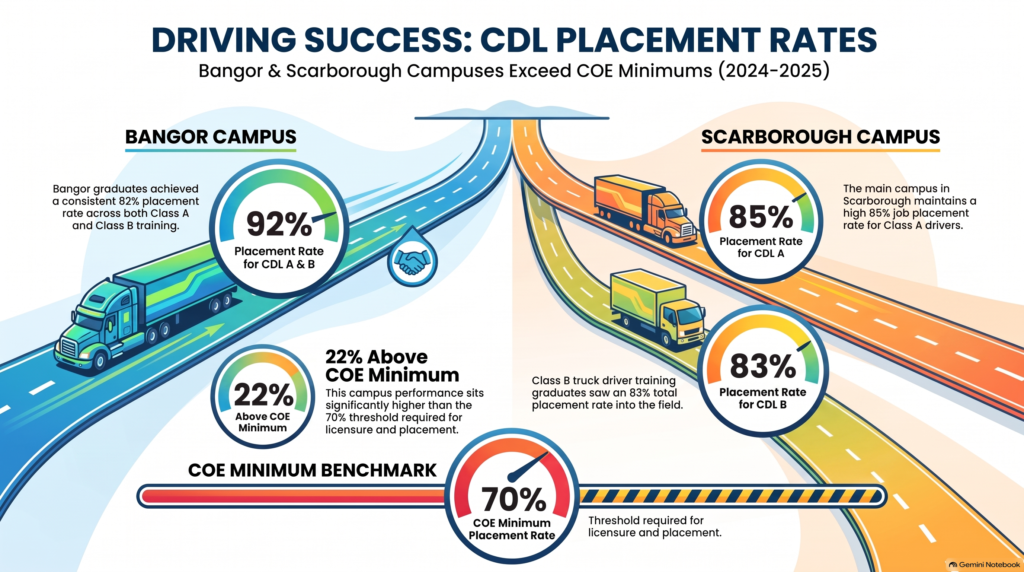
Bangor campus: 96% graduation rate · 92% total placement rate · 93% licensure rate
Scarborough campus: 92% graduation rate · 85% total placement rate · 95% licensure rate
Both campuses clear COE’s required minimums by a wide margin — 60% for graduation/completion, 70% for placement and licensure — and both land well above NTI’s own long-stated benchmark: the school notes that COE requires it to place at least 70% of graduates in their field, and that its rate in recent years has run in the high 80s to low 90s.
NTI figures are CDL-A specific, COE-audited placement rates (Jul 2024–Jun 2025). WIOA figures are general employment rates across all funded trades for program year 2023 and are not CDL-specific — shown for methodology context, not a direct comparison.
So What Does “Placement Rate” Actually Mean?
This is the part that gets glossed over — and it matters, because “placement rate” isn’t a marketing term a school can define however it likes. It’s a formula, prescribed by COE, that every accredited school has to calculate the same way and submit for audit every year.
Who counts as “placed”:
- Graduates working in the field they trained for
- Graduates who entered the military
- Graduates continuing their education
- Even students who left the program before finishing, if they picked up enough skills to land field-related work
What “the field” means: COE defines it broadly — placement counts work in the wider field that uses the training, even if the job title doesn’t literally say “CDL driver.” A grad working in a trucking-adjacent role can still count.
Who’s left out of the calculation entirely:
- Graduates still waiting to take (or get results from) a required licensure exam
- Graduates documented as unavailable for employment — serious health issues, caregiving responsibilities, and similar circumstances
- Graduates who refused job offers or didn’t show up for interviews the school arranged
That’s what separates a real, audited placement rate from a number a school just says out loud. NTI’s rate is the second kind — verified, standardized, and published in a document any prospective student can request. It’s a legitimate, standardized formula — every COE-accredited school calculates it the same way, which is exactly why it’s useful for comparing schools.
Why NTI’s Numbers Outpace the “Free” Alternatives
Maine also offers free and low-cost CDL training — through community colleges, adult education programs, and WIOA-funded workforce initiatives. It’s a legitimate option, and it opens doors for people who couldn’t otherwise afford training. But it’s not built, measured, or reported the same way NTI is — and that gap shows up in the numbers.
Maine’s statewide WIOA Adult program posted a 72% employment rate in the second quarter after exit for Program Year 2023; the Northeastern Workforce Board region — which covers Bangor — came in at 65%. Those aren’t CDL-specific figures (they’re blended across every trade WIOA funds, for a population that includes people facing significant employment barriers), so they’re not a direct head-to-head with NTI’s number. But the comparison still tells a real story about why the numbers land where they do:
| NTI (private, COE-accredited) | Free/WIOA-funded programs | |
|---|---|---|
| Accreditation stakes | Must hit 70%+ placement or risk losing accreditation and federal aid access | No equivalent placement threshold tied to survival of the program |
| What’s measured | Field-related employment, audited annually, published per campus and per program | General employment in any job, blended across every funded trade |
| Career support | Dedicated Career Services office working exclusively with NTI students, for the life of the school | Shared state CareerCenter system serving all WIOA participants across every sector |
| Public transparency | Full campus-by-campus disclosure required and published every year | No equivalent program-specific completion/placement disclosure found publicly for Maine CDL programs |
The honest version of “why NTI’s rate is higher” isn’t that free training doesn’t work — it’s that NTI operates under a stricter, audited standard with a dedicated placement infrastructure built around one outcome: getting you into a truck, working, as fast as possible.
What NTI Says About This Directly
To their credit, NTI is upfront about the distinction. Their own FAQ states plainly that they’re prohibited from guaranteeing job placement, even as their numbers consistently clear COE’s bar by a wide margin.
What they do offer every student, graduate or not, is ongoing career support: job coaching, resume and cover letter help, and direct connections to trucking employers — through the life of the school, not just a one-time service at graduation.
The Bottom Line
A 92% or 85% placement rate is a real, meaningful signal — it means NTI’s Career Services office isn’t a brochure line, it’s a functioning department with the track record to back it up. It’s not a guarantee — no accredited school can legally promise you a job, and NTI says so plainly. But it’s a strong, audited signal that the training holds up where it counts: in front of an employer, with a license in hand.
Start your CDL training with the school Maine trusts to get graduates not just licensed — but hired.
A CDL job placement rate is the percentage of a truck driving school’s graduates who land field-related employment, enter the military, or continue their education, calculated using a standardized formula. For COE-accredited schools like NTI, this rate is audited annually and must be published — it’s not a marketing estimate, it’s a verified outcome measure.
For the July 2024–June 2025 reporting period, NTI’s Bangor campus reported a 92% CDL-A total placement rate, and its Scarborough campus reported 85%. Both figures are audited under Council on Occupational Education (COE) standards and published in NTI’s official Completion, Placement & Licensure disclosures.
No. Placement rate reflects historical outcomes for graduates as a group, not a promise for any individual student. NTI states plainly that it’s prohibited from guaranteeing job placement — but it does provide dedicated Career Services support, including job coaching, resume help, and employer connections, for the life of the school.
Schools accredited by the Council on Occupational Education (COE) must calculate placement rates using a standardized, audited formula and submit the results annually. This includes clear rules for what counts as “placed” and which graduates are excluded from the calculation, which is why COE-audited numbers can be compared across schools — unlike self-reported claims.
Free and WIOA-funded CDL programs in Maine generally don’t publish a comparable, program-specific placement rate. NTI, as a COE-accredited private school, must hit a minimum 70% placement rate to keep its accreditation and operates a dedicated Career Services office focused solely on getting CDL-A graduates hired — factors that help explain the gap between NTI’s audited numbers and general state workforce employment benchmarks.