When you’re considering a career in information technology, one of the biggest questions isn’t simply “What will I learn?”
It’s:
What happens after I enroll?
Do students actually finish the program? Are graduates finding opportunities in the field? Does the training prepare students for the certifications and skills employers are looking for?
For students considering an IT career in Maine, Northeast Technical Institute’s latest reported outcomes provide some impressive answers.
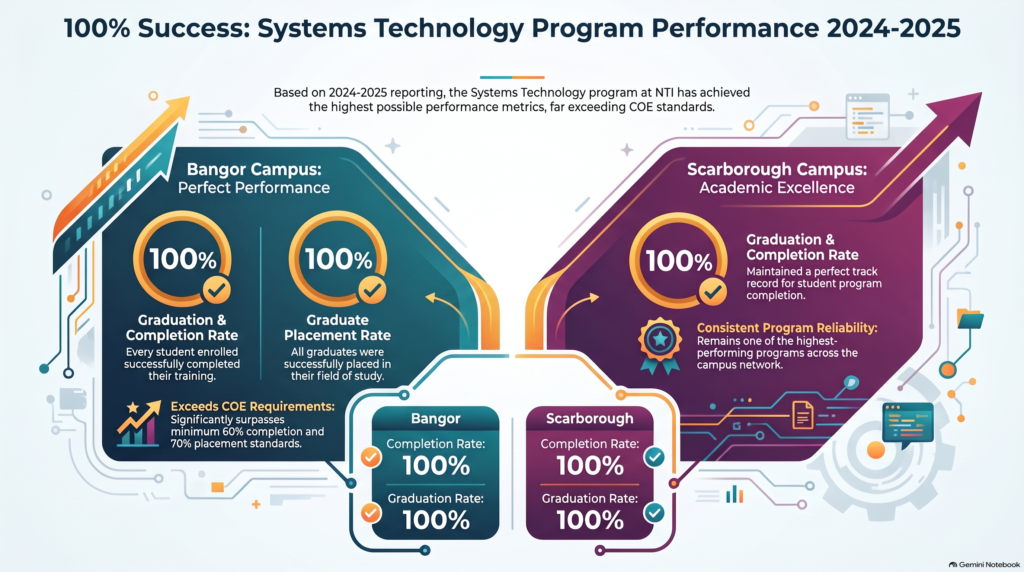
During NTI’s most recent Completion, Placement & Licensure reporting period — July 1, 2024 through June 30, 2025 — the Systems Technology program reported:
Bangor Campus
- 100% graduation rate
- 100% total completion rate
- 100% graduation placement rate
- 100% total placement rate
Auburn Campus
- 100% graduation rate
- 100% total completion rate
- 100% graduation placement rate
- 100% total placement rate
Scarborough Campus
- 100% graduation rate
- 100% total completion rate
- Placement listed as N/A for the reporting period
That means every student included in the reported Systems Technology completion calculations at all three NTI locations successfully completed the program during that reporting period. At both Bangor and Auburn, the reported placement rate was also 100%.
Those numbers don’t guarantee the same outcome for every future student, but they provide a valuable look at how NTI’s IT training has performed for recent students.

What Is NTI’s Systems Technology Program?
Systems Technology is an information technology training program designed to prepare students for entry-level IT careers involving computers, networks, software, systems administration and information security.
Rather than concentrating on one narrow area of technology, the program is built around a range of foundational IT skills.
NTI says graduates are trained to analyze an organization’s technology needs and help design, implement and maintain computer infrastructure and business technology solutions.
Students can develop skills related to areas such as:
- Computer hardware and software
- Networking
- Network architecture
- Windows operating systems
- Windows Server environments
- System administration
- Network operations
- IT security
- Compliance
- Cryptography
- Troubleshooting
- Business technology infrastructure
The program is designed to be completed in approximately 34 weeks, or about eight months, and consists of 56 credits. New Systems Technology courses currently begin every eight weeks.
For many students, that creates a much faster path into IT than pursuing a traditional four-year technology degree.
NTI Systems Technology Completion Rates
Completion rate is one of the first numbers prospective students should examine when comparing career-training programs.
Starting a program is one thing.
Finishing it is another.
For NTI’s Systems Technology program, the July 2024–June 2025 results were particularly strong.
Bangor Systems Technology
NTI’s Bangor Branch Campus reported:
- 100% graduation rate
- 100% total completion rate
- 100% graduation placement rate
- 100% total placement rate
Auburn Systems Technology
NTI’s Auburn Extension Campus reported:
- 100% graduation rate
- 100% total completion rate
- 100% graduation placement rate
- 100% total placement rate
Scarborough Systems Technology
NTI’s Scarborough Main Campus reported:
- 100% graduation rate
- 100% total completion rate
Placement was listed as N/A for this program and reporting period at Scarborough.
The most notable consistency is the completion number:
Systems Technology reported a 100% completion rate at all three NTI locations.
For students looking at career training, that is an important statistic.
Career school students often balance education with jobs, families and other responsibilities. Completing an intensive technology program requires time and commitment.
NTI’s reported outcomes show that every student included in the Systems Technology completion calculations for that reporting year completed their training.
What Does a 100% Placement Rate Mean?
Placement rate can be an even more important number for prospective career-training students.
After all, the goal for many people entering a technical program isn’t simply obtaining a diploma.
It’s building skills that can help them begin a career.
At NTI’s Bangor and Auburn campuses, Systems Technology reported a 100% total placement rate during the July 2024–June 2025 reporting period.
It’s important to understand what that number represents.
NTI reports its Completion, Placement & Licensure information using formulas prescribed by the Council on Occupational Education, or COE.
COE is the accrediting organization for Northeast Technical Institute.
According to NTI’s published reporting information, COE requires a minimum:
- 60% graduation/completion rate
- 70% placement rate
- 70% licensure rate where applicable
Systems Technology’s reported 100% completion and placement results at Bangor and Auburn were therefore above those minimum benchmarks for the reporting period.
Placement numbers should not be interpreted as a guarantee that every future graduate will receive a job.
NTI specifically states that the school does not guarantee job placement.
Instead, placement statistics provide a historical measurement of outcomes among students included in a specific reporting period.
That’s an important distinction.
A 100% placement rate doesn’t mean enrolling automatically produces a job.
It means the qualifying graduates included in the placement calculation during that reporting period were reported as successfully placed.
Why Systems Technology Can Be an Entry Point Into IT
Information technology is much broader than programming.
Nearly every modern organization depends on computer systems to operate.
Businesses rely on people to configure computers, manage users, troubleshoot hardware and software, maintain networks, protect systems and keep technology functioning.
That creates multiple potential career paths for someone with foundational IT skills.
Depending on an individual’s qualifications, experience, certifications and employer requirements, Systems Technology training can help prepare students to pursue entry-level opportunities related to areas such as:
- IT support
- Help desk support
- Desktop support
- Computer support
- Network support
- Junior systems administration
- Technical support
- Network administration
- Information technology operations
The program doesn’t lock students into one specific job title.
Instead, its broader systems-focused curriculum is intended to develop a foundation that can apply across multiple areas of IT.
Prepare for Recognized IT Certifications
Another important part of entering the technology industry is certification.
Unlike career fields that depend exclusively on a college degree, IT employers frequently consider a combination of education, experience and industry certifications.
NTI’s Systems Technology curriculum is designed to prepare students for multiple nationally recognized certification examinations.
Program materials indicate that students receive preparation covering certifications associated with areas such as CompTIA IT fundamentals, computer hardware, networking, cybersecurity and Linux.
Certifications can help demonstrate that someone understands important technical concepts and has achieved an established level of knowledge.
For a new IT professional without years of work experience, that can be particularly valuable.
Instead of entering an interview with only classroom experience, a graduate may be able to demonstrate both career training and preparation for recognized industry credentials.
Flexible IT Training for Working Adults
One of the biggest barriers adults face when considering career training is scheduling.
Not everyone can leave a job and attend a traditional college campus full time for several years.
NTI’s Systems Technology program is structured differently.
The program currently takes approximately 34 weeks to complete and offers remote learning for most students, along with flexible scheduling options. NTI notes that VA students must attend on campus.
Students also have access to live and recorded lectures.
That flexibility can be important for someone trying to build a new career while balancing work or family obligations.
Classes also start more frequently than a traditional college semester.
Systems Technology courses currently begin approximately every eight weeks, giving prospective students several opportunities throughout the year to begin training rather than waiting until the next fall or spring semester.
Career Support Doesn’t End With the Classroom
Technical ability matters in IT.
But knowing how to search for jobs, prepare a resume and interview effectively matters too.
NTI’s Office of Career Development provides employment assistance to students and graduates.
Career services can include:
- Job coaching
- Resume assistance
- Cover letter assistance
- Interview preparation
- Employer connections
- Job-search assistance
NTI says Career Development is available to students during and after graduation.
Again, that doesn’t mean employment is guaranteed.
It means students aren’t necessarily left on their own once training ends.
For someone entering technology without an established professional network, having help preparing a resume, identifying opportunities and connecting with employers can be an important part of making the transition into the field.
Systems Technology vs. Cybersecurity: What’s the Difference?
Students interested in IT often immediately think about cybersecurity.
Cybersecurity is certainly an important area of technology, but it isn’t the only path into the industry.
Systems Technology provides broader training around the computer and network infrastructure that organizations rely on every day.
That can include understanding:
- Operating systems
- Computer hardware
- Networks
- Servers
- Security
- Troubleshooting
- System administration
Those foundational skills can be valuable even for someone who eventually wants to specialize in cybersecurity.
Before you can protect a network, it helps to understand how that network operates.
Before you can secure an operating system, you need to understand how that operating system is configured and maintained.
Systems Technology therefore can provide students with a broad IT foundation rather than forcing them to immediately specialize in one area.
Is an Eight-Month IT Program Worth It?
There isn’t one educational path that’s right for everyone.
Some technology careers may require advanced degrees, extensive work experience or specialized certifications.
Others offer opportunities for people who can demonstrate practical technology skills and industry knowledge.
That’s why prospective students should look beyond simply asking how long a program takes.
Look at what the program teaches.
Look at the certifications it prepares you for.
Look at the flexibility of the training.
Look at the career resources available after graduation.
And importantly, look at the school’s actual reported student outcomes.
For NTI’s Systems Technology program, the latest published results provide some particularly strong numbers.
During the July 1, 2024–June 30, 2025 reporting period:
Bangor
100% completion. 100% placement.
Auburn
100% completion. 100% placement.
Scarborough
100% completion, with placement listed as N/A for the reporting period.
No statistic can predict what will happen for an individual student.
But historical completion and placement data gives prospective students something concrete to consider when researching their options.
Start Training for a Career in Information Technology
Breaking into IT can feel intimidating.
Technology changes quickly, job titles can be confusing and it can be difficult to know where to start.
Career-focused training can help create a clearer path.
NTI’s Systems Technology program is designed to provide students with foundational knowledge across computers, networking, systems administration and security while helping prepare them for recognized IT certifications.
The program can be completed in approximately eight months, offers flexible learning options and provides access to career-development assistance after graduation.
Most importantly, recent student outcome numbers give prospective students a way to evaluate what has happened for those who came before them.
For the July 2024 through June 2025 reporting period, Systems Technology achieved a 100% reported completion rate at Scarborough, Auburn and Bangor — while Auburn and Bangor also reported 100% placement rates.
For students considering a new career in information technology, those results make NTI’s Systems Technology program worth a closer look.
Ready to Learn More About Systems Technology?
Explore Northeast Technical Institute’s Systems Technology training program, review upcoming class dates or speak with NTI Admissions to learn whether the program fits your career goals.
Your next career in technology could begin with your first step into IT training.
About the Data
Completion and placement figures referenced in this article are based on Northeast Technical Institute’s Completion, Placement & Licensure reporting for July 1, 2024 through June 30, 2025.
Rates are calculated according to formulas prescribed by the Council on Occupational Education. Completion and placement rates represent a specific reporting period and do not guarantee individual student outcomes. Placement for Scarborough Systems Technology was reported as N/A for this reporting period.